New Vauxhall Grandland Review

Although many people think of small family hatchbacks when they think of Vauxhall, the company has had its fair share of bigger cars over the years, writes Tim Barnes-Clay.
For years, its lineup has included a mixture of MPVs, crossovers, and SUVs, the largest of which is the Grandland SUV. Formerly known as the Grandland X, it has been redesigned and relaunched. As a result, Vauxhall has achieved something significant by being one of the first manufacturers to usher in an electrified version of every car it makes. No seven-seater model is offered, but Vauxhall’s newly launched Frontera crossover will provide a third row of seats instead.
The Grandland is based on the STLA Medium platform from parent company Stellantis, which has many other brands in its stable nowadays, including Peugeot. Vauxhall, though, hopes its revitalised design language, seen on some of its recent models, such as the Astra, Corsa, and Mokka, will be enough to dissuade customers from going elsewhere.

Various trims are offered on the Grandland, and they include stylish alloys, a large infotainment touchscreen with Apple CarPlay/Android Auto, DAB radio, dual-zone climate control, cloth fabric seats, LED headlights and rain-sensing wipers.
The GS model, tested here, gets a larger 16.0-inch infotainment touchscreen, which adds SatNav and heated front seats. You also get an illuminated Vauxhall logo and light bar on the ‘Vizor’ – the signature black strip that replaces the conventional grille at the front of the car. Pixel 3D headlights, vinyl inserts for the seats, a wireless charging pad, a black-coloured roof, and rear privacy glass are also included.
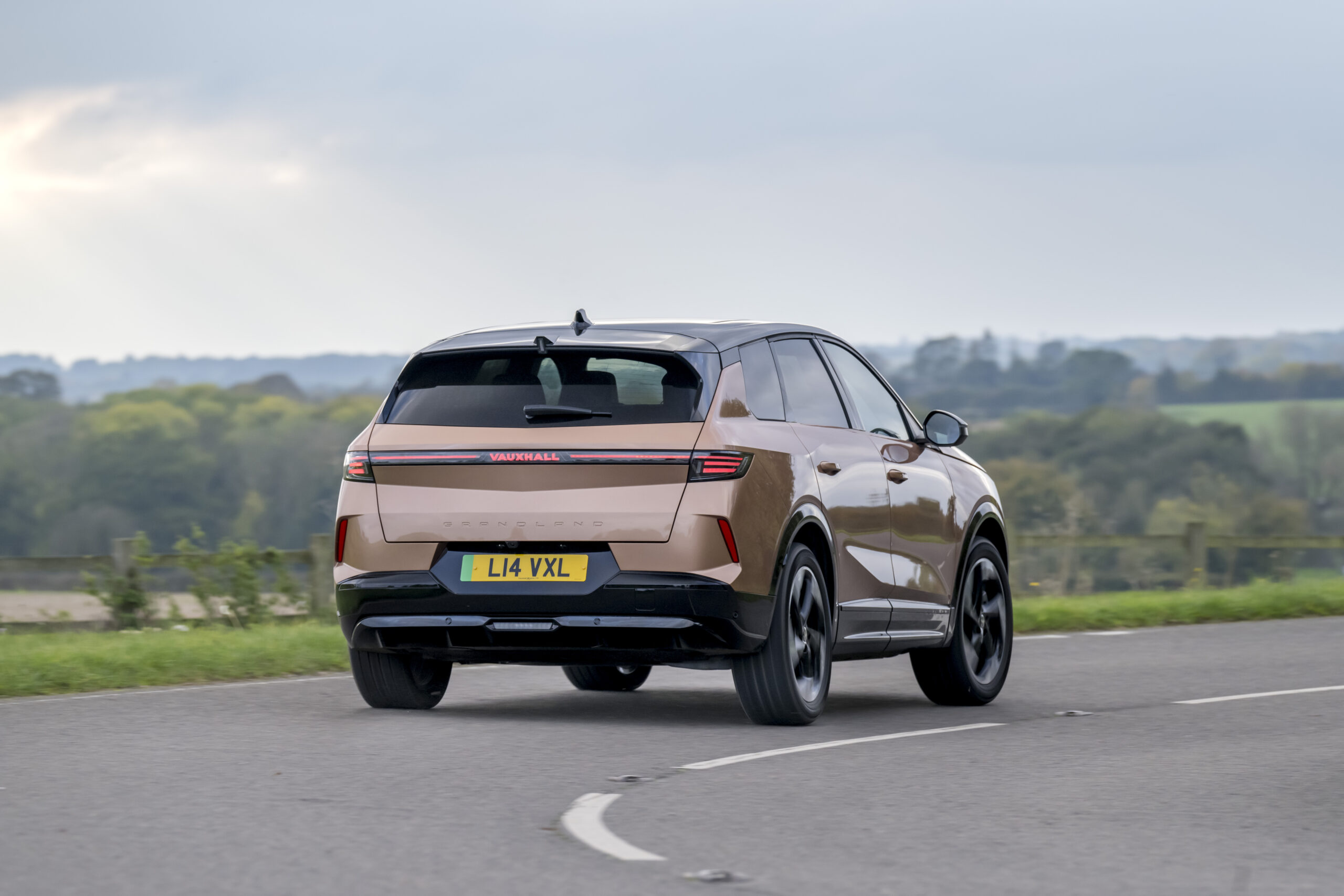
If you’re familiar with the old Grandland, you’ll likely notice that the new one is quite a bit bigger. It is taller, wider and longer – over 17cm in the latter’s case – than the outgoing Grandland, so that should help enhance practicality.
As we mentioned earlier, Vauxhall’s new design language, the centrepiece of which is its ‘Vauxhall Vizor’ grille panel, brings uniformity to the entire range. It gives the new Grandland a contemporary visual appeal, especially at night, when the front Vauxhall badge lights up, although it doesn’t do this on the entry-level model. Regardless, the front end looks clean, uncluttered and well thought out, with plenty of blank space and small slits for the air intakes at each side.
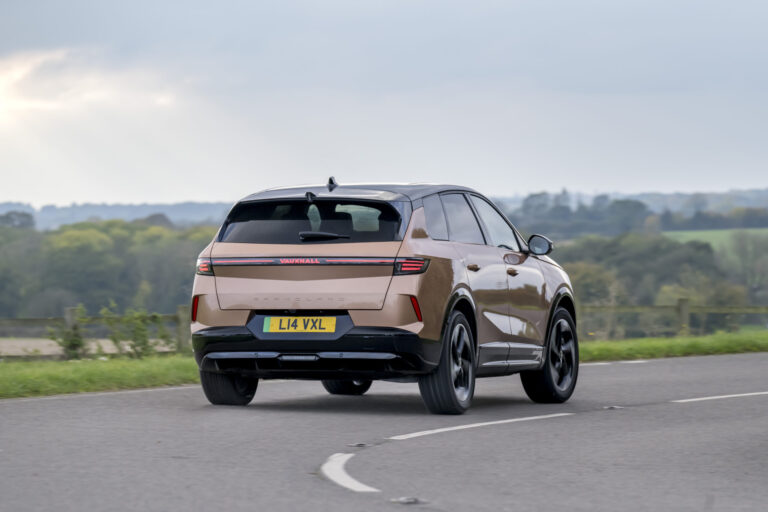
When viewed from the side, the roofline slopes towards the rear of the car. The bodywork is uneventful until you reach the bottom of the doors, which feature a very aggressive, sharp crease above the thick cladding that runs underneath and around the wheel arches.
The rear appears to be inspired by the front end, with a similar ‘Vizor’-like light bar running along the boot. This features capitalised Vauxhall lettering, which lights up, while the Grandland name is also spelt out with capitalised lettering underneath. The rear fog lights sit on the outer edges, looking more like air intakes, while the cladding is more prominent at the rear, extending upwards to cover the area behind the number plate.
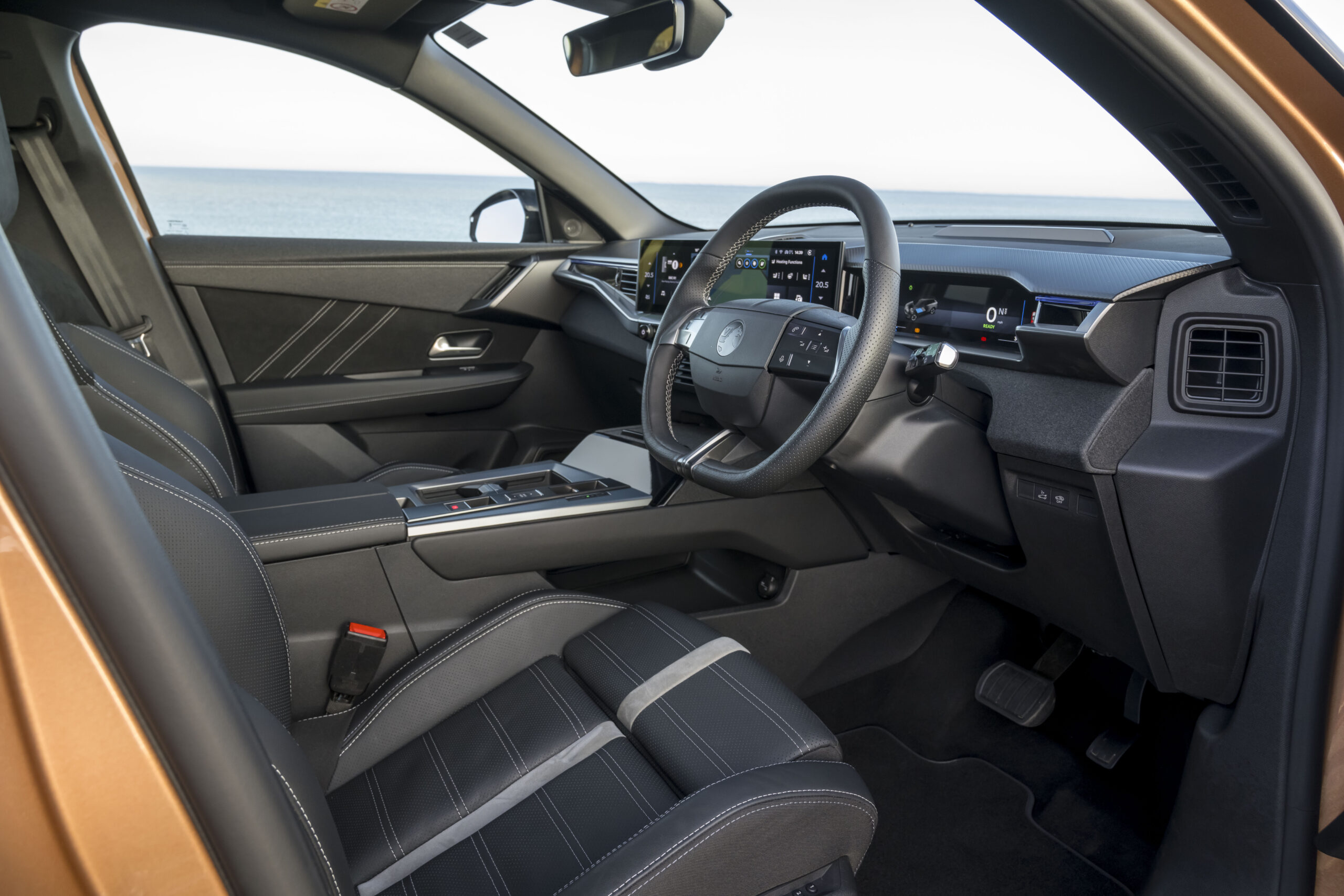
Like the exterior, the interior looks inviting. The materials seem plush and lack the cheapened feel of Vauxhalls from a decade ago. Although there are some thinner plastics, most are hidden from view. There is also a lot of silver décor, which brightens up the cabin pleasingly. The centre console, nearly all silver, sits very high up, creating a cocooned cockpit-like feel when seated behind the wheel. It is enhanced further by the dashboard layout, which is convenient and slightly angles the impressive-looking infotainment screen towards the driver.
The steering wheel also impresses, offering thumb indentations, more silver décor, plenty of multifunctional buttons, and, on all but the entry-level trim, it’s perforated. There is no electric seat adjustment on the Grandland, but there is plenty of travel in the seat and steering wheel to maximise the range of available driving positions. You feel like you’re sitting quite high up, too.
The windscreen pillars are thin, which helps maximise forward visibility, but the rear side windows don’t extend all that far back, so the rear pillars are enormous by comparison. This, added to the relatively shallow rear windscreen, limits rearward visibility. Thankfully, parking sensors at the back and front help to overcome the issue. The GS trim reviewed here gets a rear-view camera, too.
Despite the cocooning feel of the driver’s seat, it’s very spacious, with plenty of legroom and headroom. The cabin is sufficiently wide, meaning you won’t be banging shoulders with a fellow front-seat occupant. The rear is just as good, with headroom seemingly uncompromised by the sloping roofline. Fully grown adults will be able to sit in the back in relative comfort, even if taller people are occupying the front seats. Putting five adults in the Grandland is doable, although the middle seat in the back isn’t as wide or as comfortable as the outer seats, but this shouldn’t be a deal-breaker.

The infotainment display is nice to look at. It features attractive, modern graphics and a high-resolution screen that makes the text easily readable. The screen can sometimes lag, though, but it’s generally reasonably responsive to your inputs and is a step forward from previous Vauxhall systems. The menu layout is also relatively simple to understand, and there are some physical shortcut buttons to navigate to certain menus quickly.
Despite Vauxhall’s advancements with its infotainment, it has happily foregone the trend of modern systems that integrate air conditioning controls into the touchscreen. While such a move declutters the interior, it makes adjusting the temperature on the move a lot trickier in most cars, so it’s a relief that Vauxhall has kept physical buttons beneath the screen.

There is also an equally clear digital instrument display behind the steering wheel, which offers plenty of helpful information. On models with navigation, it displays the map in front of you.
The Grandland hybrid, reviewed here, takes 10.2 seconds to go from 0 to 62mph, which isn’t bad, but it could be quicker. The power feels like it’s delivered gradually rather than in one big dollop, like in many mild-hybrid cars. As a result, accelerating to overtake can feel more cumbersome than in some rivals, which deliver an instant burst of acceleration as soon as you press the pedal.
The Grandland’s handling is better than expected, thanks to a firm setup which limits body roll around faster corners. It isn’t much fun to drive, though, as the steering’s failure to weight up in the bends deprives you of feedback through the wheel, meaning you don’t feel incredibly connected to the driving experience.
The firmness isn’t uncomfortable, but it does provide a bit of rigidity to the Grandland’s ride, meaning it often feels unsettled and doesn’t seem especially well planted. It feels more relaxed at higher speeds, though, and is quite refined at 70mph, especially as the noise from the world outside is well filtered out when inside the cabin.

Crash-test safety experts Euro NCAP has awarded the Grandland four out of five stars. Vauxhall has a reasonably good safety record, with the last four Vauxhalls achieving four-star ratings, too. Nowadays, most manufacturers can comfortably earn five stars, so Vauxhall is likely to seek improvement in this area.
The Grandland has plenty of safety technology, including automatic emergency braking, lane keep assist, adaptive cruise control with stop and go, and driver drowsiness alert and traffic sign recognition.
For more information on the Vauxhall Grandland, click here.